A Cancer in the Family by Theodora Ross Md PhD
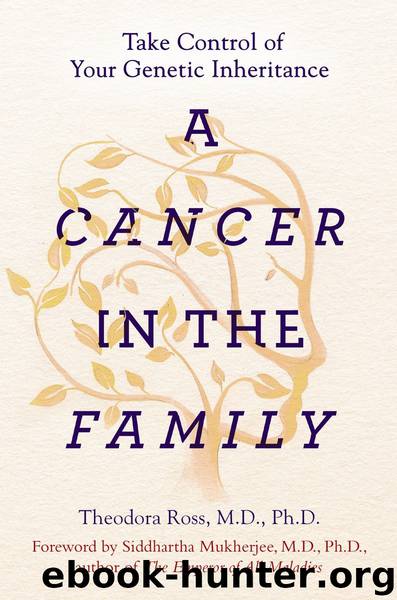
Author:Theodora Ross, Md, PhD
Language: eng
Format: epub
Publisher: Penguin Publishing Group
Published: 2016-01-18T16:00:00+00:00
Facing Medical Uncertainty
There are times when doctors can be absolutely certain about a person’s risk level and about the best avenue of treatment, but this is rare. Most of the time, there is considerable uncertainty about what the actual risk is for any particular person with a mutation. It depends partly on environment and your family history and, probably, on the presence of other, as-yet-undiscovered mutations that might modify the risks associated with the first mutation. There are also some newly discovered genes and mutations that are associated with a modestly higher-than-normal cancer risk, but these haven’t been studied long enough for us to know just how much higher. Our catalog of these “lower-risk” genes, ones we don’t understand very well, is multiplying as we learn more about human genetics.
This means that when you choose how to manage your risk, you will have to accept the fact that the data are limited. You have to do the best you can with the facts as they’re currently known. For some people, this is a situation that provokes high levels of anxiety. When we see patients who are agonizing over their decision, we feel for them and also respect that they are wrestling with tough choices. I express my confidence that they will come to a choice that is best for them. The counselors and I also emphasize that making decisions is usually a process, not an event, and it happens one small step at a time.
I’m more worried when patients use the absence of data as an excuse for head-spinning denial. “My sister only had a touch of leukemia, so that’s good. Now you say you can’t be sure that I’ll definitely get cancer, right?” they say. “Well, then I’m probably going to be fine. That’s great news! Thanks for letting me know! Bye-bye!” When this happens, the genetic counselors and I are in the odd position of trying to increase patients’ anxiety, trying to increase their ability to hear us. We want them to feel a healthy level of concern, one that motivates them to assess the facts and make a conscious, thoughtful decision. Many health professionals, including me, have frequently noticed that the lower the risk of cancer, the more anxiety a person tends to experience.
When it came time for me to make my decisions, it helped that I had a high-risk combination: a nasty mutation, a big family history of cancer, and a personal history of cancer (thankfully, it too was just a “touch” of melanoma). It was clear to me that I needed to take action. Nevertheless, I still encountered uncertainty. What were the best procedures to have? Should I have multiple procedures at the same time or separately? Where should I have them done? Should I book with the surgeon with the best technical reputation, or a surgeon known for having a human touch? Should I get reconstructive surgery?
In 2010, the British medical journal Lancet published an essay by Caroline Wellbery, a professor in the Department of Family Medicine at Georgetown University, about the value of medical uncertainty.
Download
This site does not store any files on its server. We only index and link to content provided by other sites. Please contact the content providers to delete copyright contents if any and email us, we'll remove relevant links or contents immediately.
Men In Love by Nancy Friday(5229)
Everything Happens for a Reason by Kate Bowler(4729)
The Immortal Life of Henrietta Lacks by Rebecca Skloot(4571)
Why We Sleep by Matthew Walker(4428)
The Sports Rules Book by Human Kinetics(4377)
Not a Diet Book by James Smith(3407)
The Emperor of All Maladies: A Biography of Cancer by Siddhartha Mukherjee(3138)
Sapiens and Homo Deus by Yuval Noah Harari(3057)
Day by Elie Wiesel(2777)
Angels in America by Tony Kushner(2641)
A Burst of Light by Audre Lorde(2588)
Endless Forms Most Beautiful by Sean B. Carroll(2468)
Hashimoto's Protocol by Izabella Wentz PharmD(2365)
Dirty Genes by Ben Lynch(2311)
Reservoir 13 by Jon McGregor(2293)
Wonder by R J Palacio(2201)
And the Band Played On by Randy Shilts(2185)
The Immune System Recovery Plan by Susan Blum(2051)
Stretching to Stay Young by Jessica Matthews(2023)
